
Learning Behaviours
Positive learning behaviours – such as persistence, engagement, curiosity and self-regulation — are associated with higher academic outcomes.
— Education Endowment Foundation (EEF)
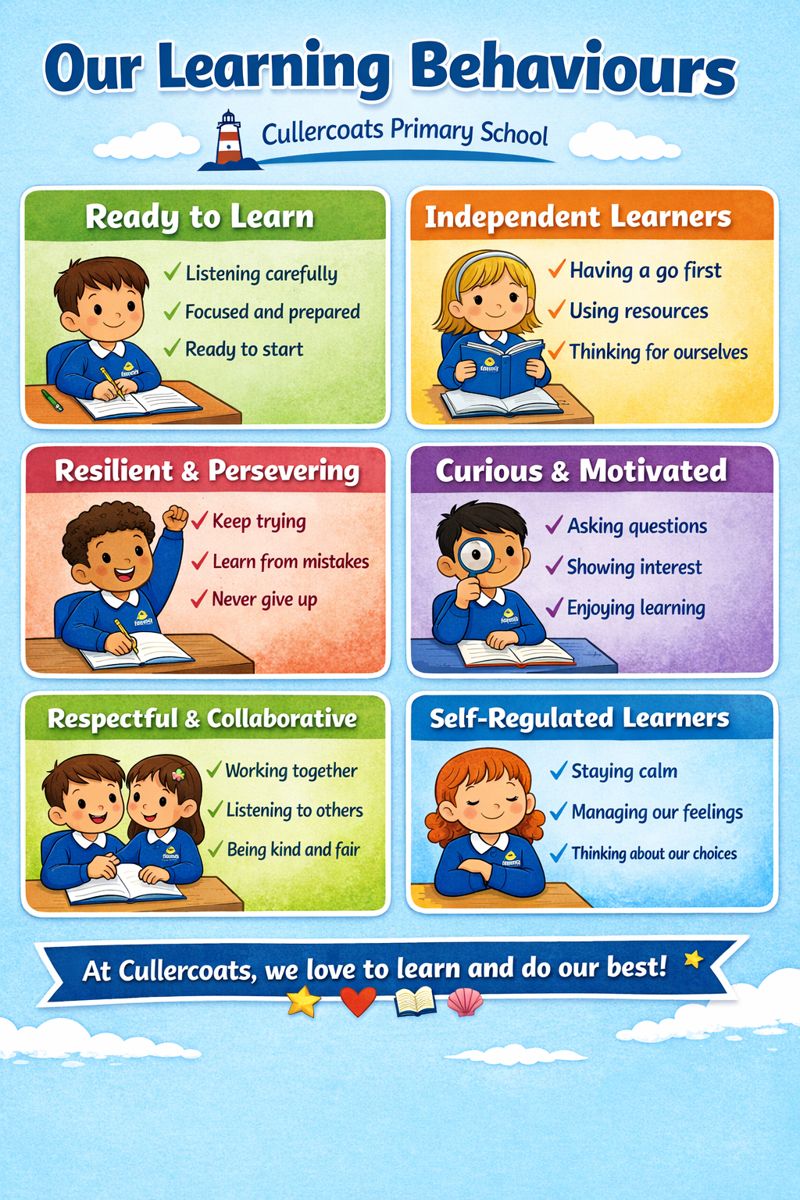
Learning Behaviours at Cullercoats Primary School
At Cullercoats Primary School, we believe that how children learn is just as important as what they learn. Our learning behaviours underpin everything we do and help our pupils to become confident, resilient and independent learners.
These behaviours are explicitly taught, modelled by adults and reinforced consistently across the school. They support our high expectations and align with the current Ofsted framework, particularly Behaviour and Attitudes and Quality of Education.
What are learning behaviours?
Learning behaviours are the attitudes, habits and skills that help children to engage positively with learning. They enable pupils to focus, persevere, work independently and collaborate effectively with others.
By developing strong learning behaviours, pupils are better equipped to: - Make good progress - Manage challenge and setbacks - Take responsibility for their learning - Prepare successfully for the next stage of education
Our Learning Behaviours
Ready to Learn
Pupils are prepared, focused and engaged in learning.
This means they: - Listen carefully and follow instructions - Settle quickly and make good use of learning time - Arrive ready with the right attitude and equipment
Independent Learners
Pupils take increasing responsibility for their learning.
This means they: - Have a go before asking for help - Use classroom resources to support their learning - Work independently for age-appropriate periods of time
Resilient and Persevering
Pupils keep going when learning is challenging.
This means they: - Understand that mistakes are part of learning - Accept and respond positively to feedback - Try different strategies when something feels difficult
Curious and Motivated
Pupils show enthusiasm and a love of learning.
This means they: - Ask questions and explore ideas - Make links between what they already know and new learning - Take pride in their work and achievements
Respectful and Collaborative
Pupils learn well with and alongside others.
This means they: - Listen to others and value different viewpoints - Work cooperatively in pairs and groups - Show respect for adults, peers and the learning environment
Self-Regulated Learners
Pupils manage their emotions and behaviour to support learning.
This means they: - Use strategies to stay calm and focused - Manage frustration and excitement appropriately - Reflect on their learning and behavior
A Whole-School Approach
Our learning behaviours are: - Taught explicitly across all year groups, including EYFS - Modelled consistently by all staff - Adapted to meet the needs of all pupils, including those with SEND - Reinforced through feedback, praise and reflection
By working in partnership with parents and carers, we aim to support every child to develop the learning behaviours they need to succeed both now and in the future.
At Cullercoats Primary School, we are proud to develop learners who are ready, resilient and respectful – every day.
Research and Evidence Underpinning Our Approach
At Cullercoats Primary School we use evidence-informed practice to shape both what we teach and how we support pupils to learn. Research from the Education Endowment Foundation (EEF) and Barak Rosenshine’s Principles of Instruction help us to make high-quality learning behaviours meaningful and effective in everyday classrooms.
Education Endowment Foundation (EEF)
The EEF is a widely respected UK charity dedicated to improving educational outcomes through research-based evidence and practical guidance for schools. Its work supports schools to make informed decisions about teaching and learning that maximise pupil progress. (Wikipedia)
Learn more about EEF’s research and resources:
Education Endowment Foundation (EEF)
Rosenshine’s Principles of Instruction
Rosenshine’s Principles are a set of research-based teaching strategies grounded in cognitive science and the study of effective classroom practice. These principles include practices such as:
- Reviewing prior learning before new material
- Presenting content in small steps
- Providing opportunities for guided and independent practice
- Checking for understanding regularly
These strategies support the development of strong learning behaviours in pupils, such as perseverance, reflection and independence. (Google Sites)
Read an accessible summary of the principles:
Rosenshine’s Principles of Instruction – St Mary’s University summary
How This Links to Learning Behaviours
Our learning behaviours — Ready, Independent, Resilient, Curious, Respectful, Self-Regulated — are supported by both:
- EEF’s evidence-based guidance, which emphasises strategies such as metacognition and feedback that help pupils think about their own learning, stay motivated and respond positively to challenge, and
- Rosenshine’s Principles, which promote clear instructional design and practice that enhance pupil engagement and mastery.
By integrating research into classroom practice, we help children not only learn knowledge and skills, but also learn how to learn effectively.